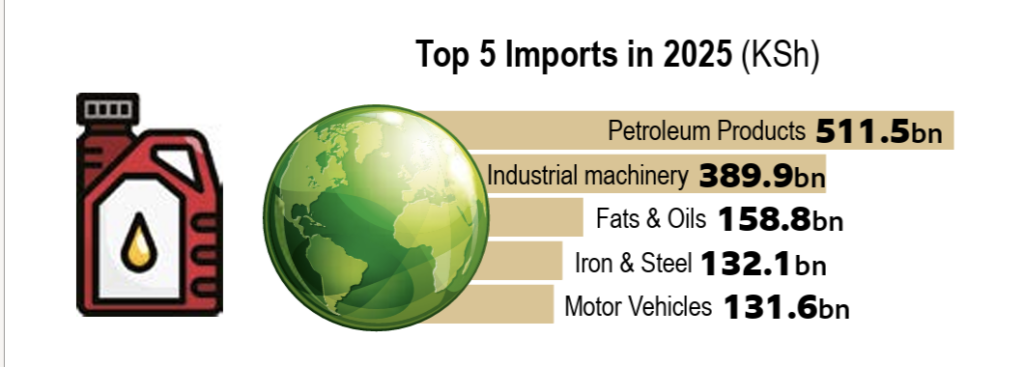
Kenyans imported motor vehicles worth Sh131.6 billion in 2025, placing cars among the country’s top five imports even as the government faces mounting pressure from rising public debt, the latest survey by the Kenya National Bureau of Statistics shows.
The Economic Survey 2026 indicates that total imports rose by 2.5 per cent to Sh2.77 trillion, driven largely by demand for fuel, machinery and transport equipment.
Petroleum products remained the largest import at Sh511.5 billion, while industrial machinery imports stood at Sh389.9 billion, signalling continued investment in infrastructure and production. Imports of iron and steel and fats and oils also featured prominently, reflecting demand from construction and manufacturing sectors.
The strong appetite for imports comes amid rising domestic demand for energy. The quantity of petroleum products imported increased by 12.2 per cent to 5.5 million tonnes, while overall domestic demand for petroleum rose by 9.9 per cent.
However, the rising import bill continues to strain Kenya’s external position. The trade deficit widened to Sh1.65 trillion as export growth remained sluggish at 0.6 per cent to Sh1.12 trillion. Key exports remained tea, cut flowers, horticulture, coffee and apparel.
The export-import cover ratio declined to 40.4 per cent, highlighting Kenya’s growing reliance on external financing to meet its import needs. This pressure was reflected in the current account deficit, which widened to Sh373.3 billion. Diaspora remittances, a key source of foreign exchange, declined to Sh661.2 billion from Sh674.1 billion in 2024.
Public debt rose to Sh11.4 trillion, with the government projecting expenditure of Sh4.27 trillion against revenue of Sh3.38 trillion in the 2025/26 financial year, pointing to a significant budget deficit. Debt servicing remains a major burden, with Sh851 billion allocated to interest payments alone.
In the labour market, informal employment continued to dominate, accounting for 83.8 per cent of total jobs, equivalent to about 18.1 million people, compared to 3.5 million in formal employment. Formal sector employment grew modestly by 4.0 per cent, with the private sector employing 2.25 million people.
Inflation eased to about 4.5 per cent in 2025, down from higher levels in previous years, although food prices showed mixed trends. While cereal prices declined, the cost of vegetables rose sharply by 15.9 per cent, and fish prices increased by 13.6 per cent.
Sectoral performance was mixed. Agriculture, the largest contributor to the economy, grew by 2.8 per cent, supported by increased maize and milk production, although sugarcane output declined significantly. Manufacturing growth slowed to 2.1 per cent, weighed down by a contraction in sugar production.
On a positive note, the construction sector rebounded strongly, expanding by 6.8 per cent compared to a contraction in 2024, supported by increased cement consumption and private sector lending. The transport sector also showed resilience, with cargo throughput at the Port of Mombasa rising by 11.2 per cent and new vehicle registrations increasing to 395,235 units.
Tourism recorded steady recovery, with international arrivals rising by 6.2 per cent to 2.55 million visitors, while visits to national parks and reserves grew by 5.7 per cent.
The financial sector remained stable, with bank lending rates declining in line with a reduction in the Central Bank Rate to 9.0 per cent. Pension assets rose sharply by 27.4 per cent to Sh2.81 trillion, indicating growing long-term savings.
In the ICT sector, mobile subscriptions grew by 21 per cent to 51.4 million, while total mobile money transfers surged to Sh8.66 trillion, reflecting deepening digital financial services.
Presenting the findings, KNBS Director General Macdonald Obudho said the survey provides critical insights into the country’s economic direction.
“The Economic Survey provides an overview of socio-economic trends and is a key resource for informing planning, budgeting and policy formulation,” he said.